Blog post
On December 15, 2022, Catchpoint launched Internet Performance Monitoring (IPM) as a new category for monitoring solutions with our foundational article, “What is Internet Performance Monitoring and How is it Different from APM?”
In it, we said:
“Internet Performance Monitoring (IPM) is a new generation of solutions that provide deep visibility into every aspect of the Internet that impacts your business. IPM tools will become essential for any organization that requires a resilient Internet to operate – which, let’s face it, is pretty much everyone out there.”
How prophetic those words turned out to be.
Within three years, what began as a new idea is now defined by Gartner as a distinct discipline in the Digital Experience Monitoring (DEM) market, with Catchpoint recognized as a Leader in the first-ever Gartner Magic Quadrant for DEM, and again in 2025 as IPM becomes core to how Gartner evaluates DEM platforms.
This is the story of how we went from that first foundational article to a recognized category, and what other companies can learn from the journey.
Why a new category was needed
When we started down this path, most “monitoring and observability” vendors were converging around similar language: digital experience, observability, APM, NPM, DEM. The market was crowded with powerful platforms that largely framed the problem as “understand what is happening inside your applications and infrastructure.”
The challenge our customers faced looked different.
Over the previous decade, and especially through the acceleration of the COVID-19 pandemic, the world had change:
- From everything on the LAN to everything distributed
- From monolithic apps in one data center to cloud‑hosted, SaaS, and multi‑cloud architectures
- From a mostly office‑based workforce to global, remote, hybrid workforces
As a result, the biggest blind spot was no longer the application stack. It was the Internet itself: a complex mesh of ISPs, CDNs, DNS, BGP routes, SASE, and third‑party APIs that now sit between users and the applications they rely on.
Traditional APM and observability platforms were indispensable for code‑level and application‑level insight. But they were not built to answer questions like:
- Why are users in Frankfurt on one ISP seeing severe latency, while users in Boston on another ISP are fine?
- What are the real-world response times for the internal and external APIs our critical systems rely on?
- Why did a BGP route flap, DNS misconfiguration, or CDN issue take out a business‑critical workflow for a specific region?
- What is the latency between our cloud sites and how is that impacting our users?
- Why is “slow” the new “down” for a distributed customer base, even when the app stack is healthy?
We needed language that made this Internet‑layer dependency explicit, distinct, and urgent.
Defining the Internet Stack and naming IPM
The first breakthrough was conceptual, not product‑driven: the Internet Stack.
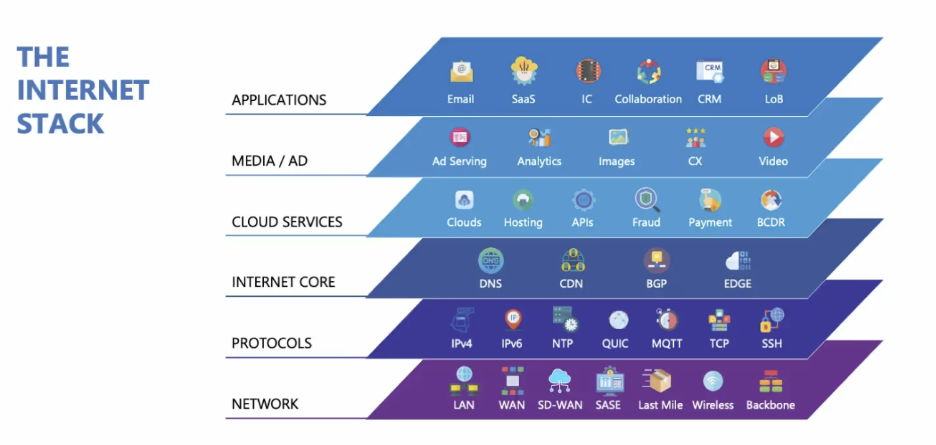
We started describing the modern environment not just as an “application stack,” but as an Internet Stack, the interconnected networks, services, and protocols that sit between users and applications: DNS, BGP, CDNs, edge networks, APIs, SASE, ISPs, wireless carriers, and more.
This framing accomplished three things:
- It reflected what customers were actually dealing with: a fragile, distributed, multi‑party Internet path that they did not fully control.
- It gave a neutral, industry‑useful label to a real set of dependencies (not just a branded feature name).
- It created space for a new kind of monitoring focus: not “inside the app,” but “across the Internet.”
From there, the name of the category followed naturally. If Application Performance Monitoring (APM) is for the application stack, and Network Performance Monitoring (NPM) is for the traditional network, then Internet Performance Monitoring (IPM) should be for the Internet Stack.
We also drew a clear boundary:
- APM focuses on code and application internals.
- IPM focuses on the network and Internet path, measuring what customers and employees actually experience as they traverse the Internet from last‑mile to cloud.
This simple contrast — “APM for your app stack, IPM for your Internet Stack” — became one of the most effective ways to make the category real in people’s minds.
Repositioning around Internet resilience
Defining a category is one thing. Making it matter to executives is another.
Very quickly, it became obvious that “Internet performance” on its own was still too technical. CIOs and infrastructure leaders were grappling with bigger questions:
- How do we keep the business running when everything depends on SaaS, cloud, and third‑party services?
- How do we protect revenue and reputation when a single DNS issue, BGP incident, or CDN misconfiguration can disrupt millions of users?
This led us to Internet Resilience, our outcome‑based north star.
We began to frame resilience as a combination of four factors: availability, reachability, performance, and reliability
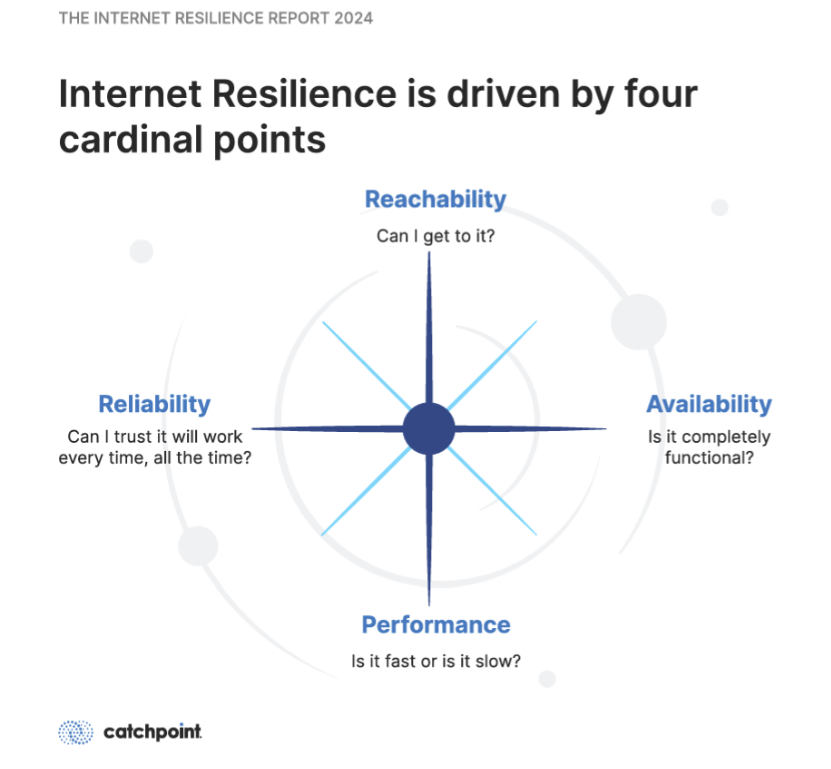
With that lens, we repositioned Catchpoint as “The Internet Resilience Company” and made IPM the underpinning discipline that enables organizations to monitor what matters, from where it matters, so they can keep digital services resilient.
The hierarchy looked like this:
- Position: The Internet Resilience Company
- Category: Internet Performance Monitoring (IPM)
- Core concept: The Internet Stack
- Outcome: Internet resilience for customers and workforce
This structure kept the messaging consistent from homepage copy to analyst briefings.
Making the category real in the market
A category only becomes real when others start using the language. To get there, we focused on four levers: content, product, brand, and analysts.
Content: teach the Internet Stack
From day one, the IPM strategy leaned heavily on educational, ungated content.
Rather than pushing product features, we wrote, spoke, and presented on:
- What the Internet Stack is and why it breaks
- How “slow is the new down” for modern distributed users
- How to troubleshoot DNS, BGP, CDN, and ISP issues that traditional tools miss
- How IPM and APM work together rather than compete
Our foundational IPM articles were followed by deep‑dive guides on BGP, CDNs, synthetic monitoring, Internet protocols, and real‑world outage analyses, all freely accessible, with the goal of building an IPM skillset in the market.
This built credibility and gave engineers and SREs a vocabulary for problems they were already facing.
Product: embody the narrative
At the same time, the platform evolved to embody the IPM and Internet Stack narrative:
- Thousands of vantage points across backbone, last‑mile, enterprise, and wireless networks
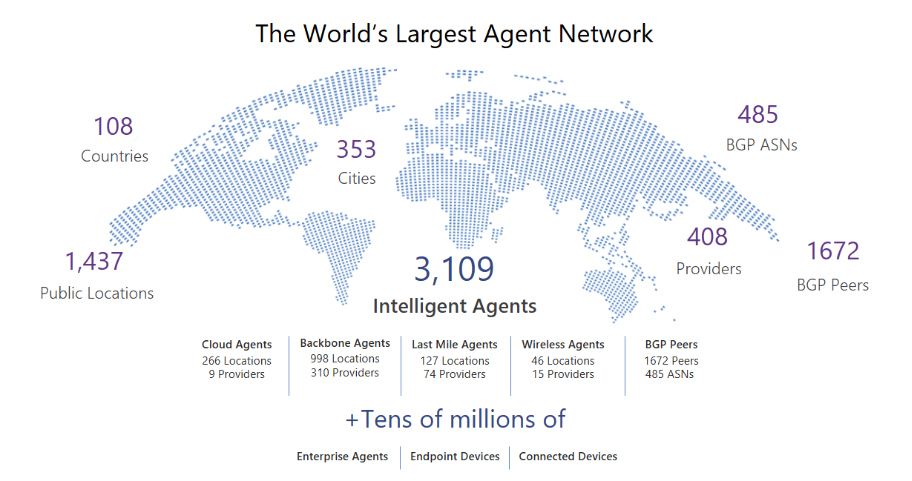
- Deep visibility into DNS, BGP, CDN, edge, APIs, and more
- Tools like Internet Sonar, Internet Synthetics, and BGP monitoring designed explicitly for Internet‑layer issues
Features like the Internet Stack Map made the concept visual and operational: customers could literally see how their traffic flowed across the Internet and where it was at risk. This was not just branding; it was a product expression of the category.
Brand and storytelling
The brand system was updated to reflect this focus:
- Visual language that emphasized global reach, Internet endpoints, and clarity
- Messaging and taglines built around resilience and visibility into the Internet Stack
- Customer quotes describing Catchpoint as “our NexRad for the Internet” and the tool they rely on to understand the Internet better than anyone else
Consistency across website, sales decks, events, and T‑shirts (“You can’t fix what you can’t see,” “Every. Millisecond. Counts.”) helped anchor the association between Catchpoint, IPM, and Internet resilience.
By 2025, Gartner described IPM as core to DEM, and Catchpoint was again recognized as a Leader as the discipline matured and the category solidified.
A playbook for creating a category
While every market is different, a few principles from this journey can be generalized for CMOs and product marketers thinking about category creation.
#1.Start with an unarticulated problem, not a product
The starting point for IPM was not “we need a new acronym.” It was the recognition that most monitoring tools could not explain Internet‑layer failures that customers were experiencing daily. That pain existed independently of Catchpoint, which made the category credible once named.
Spend disproportionate time naming the problem in language the market can adopt, not your brand.
#2. Coin a concept that can live beyond you
The Internet Stack is useful even in conversations where Catchpoint is never mentioned. It’s a neutral way to talk about Internet dependencies. That makes it more likely to be adopted by analysts, customers, and even competitors.
Define concepts (like “Internet Stack”) that others can use in their own materials without feeling like they’re saying your tagline.
#3. Make the comparison obvious
“IPM is like APM, but for your Internet Stack” is simple, memorable, and puts IPM in a familiar mental model for technical buyers.
Position the new category in relation to known ones so people can immediately understand the difference.
#4. Tie the category to an executive‑level outcome
Internet resilience gave IPM strategic relevance. It translated technical measurement into business risk and continuity.
Anchor your category in an outcome (like resilience, risk reduction, revenue protection) that boards and executives already care about.
#5. Teach relentlessly and ungate generously
IPM became real through guides, blogs, webinars, and outage breakdowns that helped people solve real problems, often before they became customers.
Make your category the default lens for understanding a problem space by teaching it better than anyone else.
#6. Align brand, product, and analyst story
The rebrand, the platform roadmap, and the analyst briefings all told the same story: the Internet Stack matters, IPM is how you see it, and Internet resilience is the outcome.
Treat positioning as an operating model, not just a messaging document. Every function should be able to trace its priorities back to the category narrative.
The Future: From Category Creation to Connected Intelligence
If the first chapter of our journey was defining Internet Performance Monitoring, the next chapter is about integrating that insight into a holistic view of the digital world.
On December 2, 2025, Catchpoint was acquired by LogicMonitor, marking the end of the era of reactive observability.
This acquisition validates everything we have built. By combining Catchpoint’s Internet‑level intelligence with LogicMonitor’s AI‑driven hybrid infrastructure visibility, we are doing something the market has needed for years: connecting what enterprises own (their hybrid infrastructure) with what they depend on (the Internet Stack).
The IPM category we created is not going away; it is graduating. It is becoming a critical pillar of a new, AI‑first platform for connected digital operations.
- The problem remains: The Internet Stack is still complex, distributed, and fragile.
- The solution evolves: Now, Catchpoint’s data, from thousands of global vantage points, will feed directly into Edwin AI, LogicMonitor’s intelligent engine.
This means moving beyond just monitoring the Internet Stack to predicting and preventing issues across the entire digital delivery chain, from code to cloud to customer.
Final takeaway
For any leader looking to define a market, remember: You can’t lead what you don’t define. But once you define it, don’t stop there. Build it, prove it, and then use it to build what comes next.
Want to learn more about IPM, start here: Mastering Internet Performance Monitoring: A best practices series
Summary
This post traces how Catchpoint named and defined Internet Performance Monitoring (IPM), from the first foundational article in 2022 to IPM’s recognition by Gartner as a core discipline in Digital Experience Monitoring, and now its evolution as part of LogicMonitor’s AI-first platform. Along the way, it offers a concrete playbook for marketing and product leaders on how to build a category around a real, unarticulated problem, from coining the “Internet Stack” to aligning product, brand, and analyst strategy around Internet resilience
This is some text inside of a div block.


