
Blog post
Reliability used to mean “are we up?” Today, customers ask something more demanding: “Are you fast, everywhere, every time?”
The SRE Report 2026 shows that this change is no longer emerging. It is already established.
Reliability now means fast
Across two years of data, one message holds steady: slow apps are dead apps. In last year’s report, a majority of organizations (53%) agreed with the phrase “slow is the new down,” even though many had never heard it before. In the 2026 report, 67% of respondents agreed that performance degradation is as serious as downtime. That belief has settled.
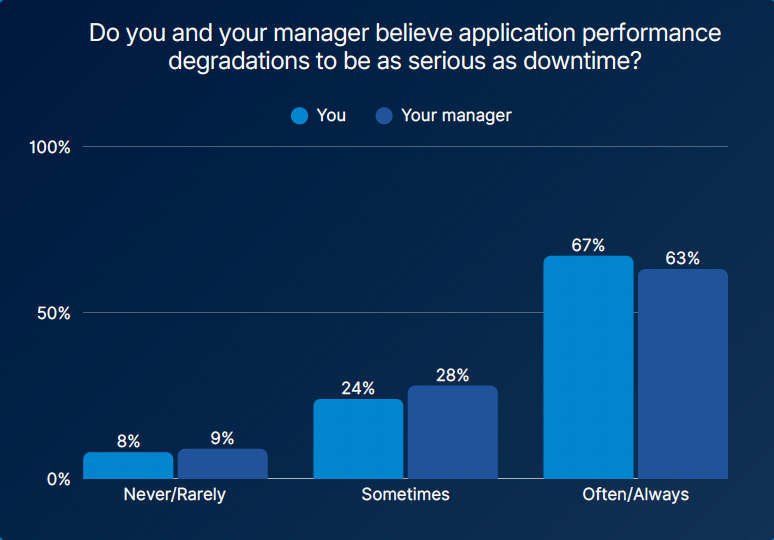
Reliability is no longer measured only by uptime. It is measured by how fast, how steady, and how confidently digital experiences work in every location where users connect. When a login hangs or a checkout page drags, customers do not care whether the cause is an outage or a delay. The result feels the same and trust drops either way.
What teams believe vs what they measure
This year’s data pushes further by testing whether belief translates into action. The report combined two questions to form a quadrant view.
- Belief: Do you consider application performance degradations to be as serious as downtime (slow as bad as down)?
- Behavior: When you improve application performance, do you also evaluate whether business metrics like NPS or revenue are affected?
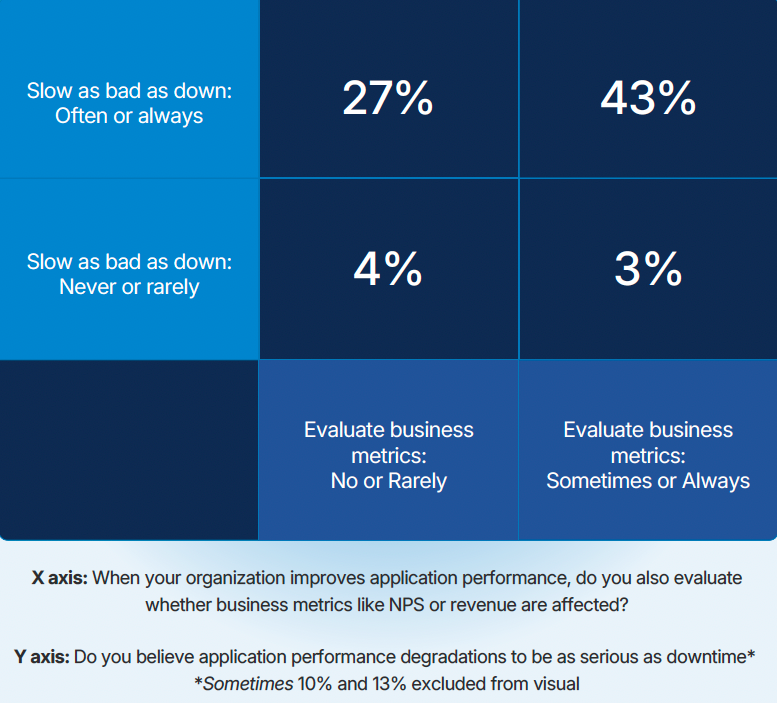
The result exposes four patterns:
- 43%: Belief plus behavior. They often or always treat slow as bad as down and also check business metrics sometimes or always.
- 27%: Belief only. They treat slow as bad as down, but do not or rarely evaluate business metrics.
- 3%: Behavior without belief. They evaluate business metrics, but don’t believe slow is as serious as downtime.
- 4%: Neither. They neither treat slow as down nor evaluate business metrics.
The quadrant reveals a pattern where most respondents now agree, in principle, that degraded performance is a reliability failure, yet fewer than half have built the feedback loops to prove what that failure costs in terms the business cares about.
The fact that most teams have mature dashboards and synthetic tests tells its own story.
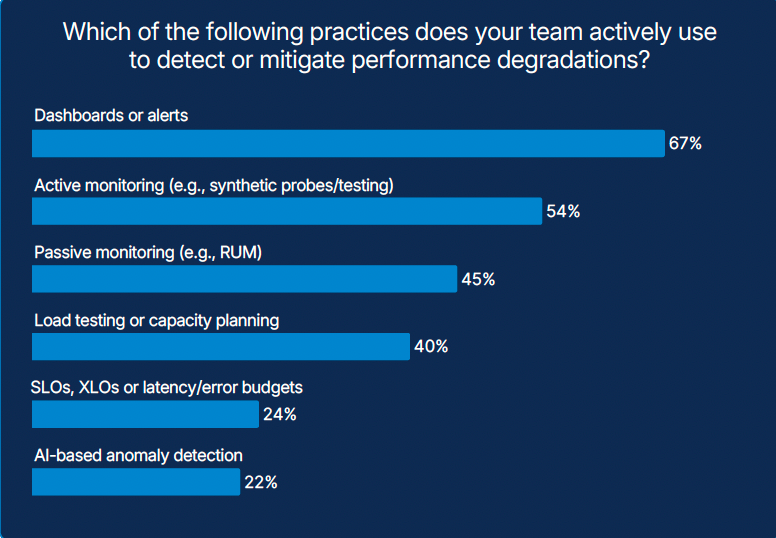
When performance data stays technical, with dashboards, alerts, and latency charts, it struggles to compete with business priorities. But when reliability is tied to outcomes customers and executives care about, it stops being an operational cost and starts becoming a strategic lever.
Teams that connect performance to outcomes see different results. Reliability work gains visibility. Prioritization becomes easier. Long-term trust becomes easier to defend.
Speed reframes the cost of impact
Another signal reinforces this point. Fewer than one in four organizations formally model the financial cost of slowness or downtime.
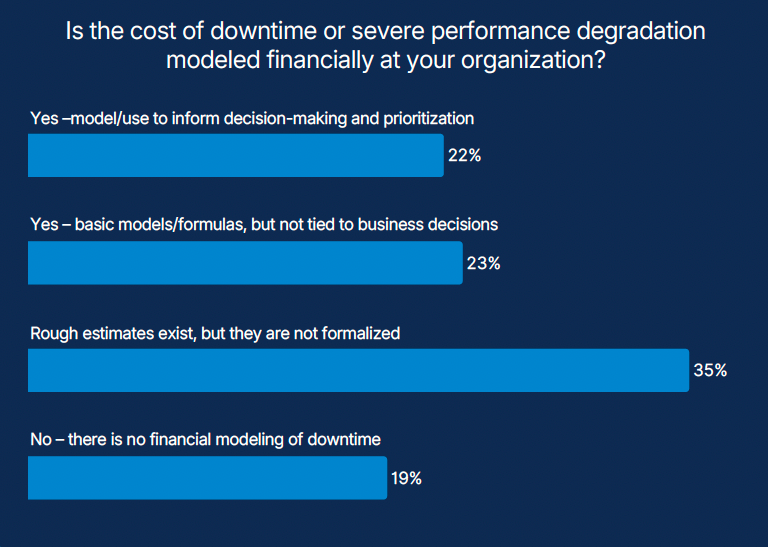
Without that context, reliability conversations stay trapped in the server room. Speed changes the framing. Delay is easier to understand than error rates. Time lost maps naturally to money lost, customers lost, trust lost. When teams can explain reliability in terms of cost, it becomes comparable, defensible, and visible at the business level.
Language matters more than we think
As reliability expands beyond engineering, language becomes a constraint or an enabler. The report shows mixed comfort with technical terms like SLOs, and growing interest in more human alternatives that clearly describe intent and impact.
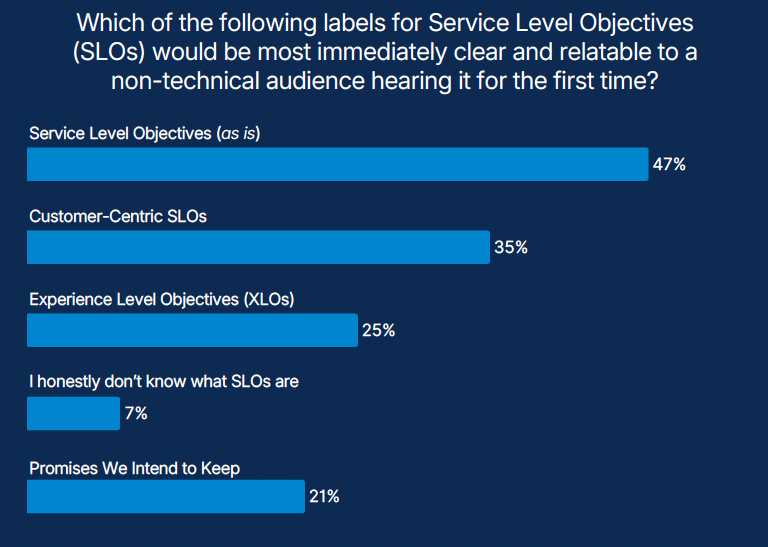
Reliability needs words that resonate outside of SRE teams. Speed does that naturally. Everyone understands fast. Everyone understands waiting. Few need a glossary to grasp why it matters.
What this means for monitoring
If speed is how trust is experienced, then monitoring that stops at your own systems is no longer sufficient.
Your customers do not experience reliability inside your cloud, your regions, or your service boundaries. They experience it on real devices, across unpredictable networks, and through providers and services you do not own. Any monitoring model that ends before the user does will systematically underestimate failure.
That is the real risk exposed by the data.
Traditional monitoring answers the question “is something broken?” Experience-led monitoring answers a harder one: “who was affected, where, and what did it cost us?”
Until those answers live in the same view, reliability will continue to compete poorly for attention and funding. Engineers may know something is wrong, but leaders cannot see why it matters now.
Closing that gap requires monitoring to do three things differently:
- Follow the experience end-to-end
Reliability signals must span the full Internet stack from the user edge through networks, routing, transport, security, cloud infrastructure, and external dependencies, reaching all the way into application services rather than ending at internal systems. - Performance signals must connect directly to business outcomes
When a journey slows, the impact on conversion, abandonment, revenue, or sentiment should already be visible. - Frame reliability in the language of promises, not components
Reliability needs a vocabulary that expresses commitments rather than components. Experience level objectives (XLOs) provide that structure.
Organizations in the belief-plus-behavior group show this pattern clearly. Their dashboards pair technical signals with business indicators. Post-incident reviews include discussion of customer impact and trust, not only time to recovery. Monitoring supports decision-making, not only troubleshooting.
Does company size matter?
When we examined the data by company size, one signal stood out clearly. Aligning reliability with business KPIs and customer experience ranks as a top priority at every scale.
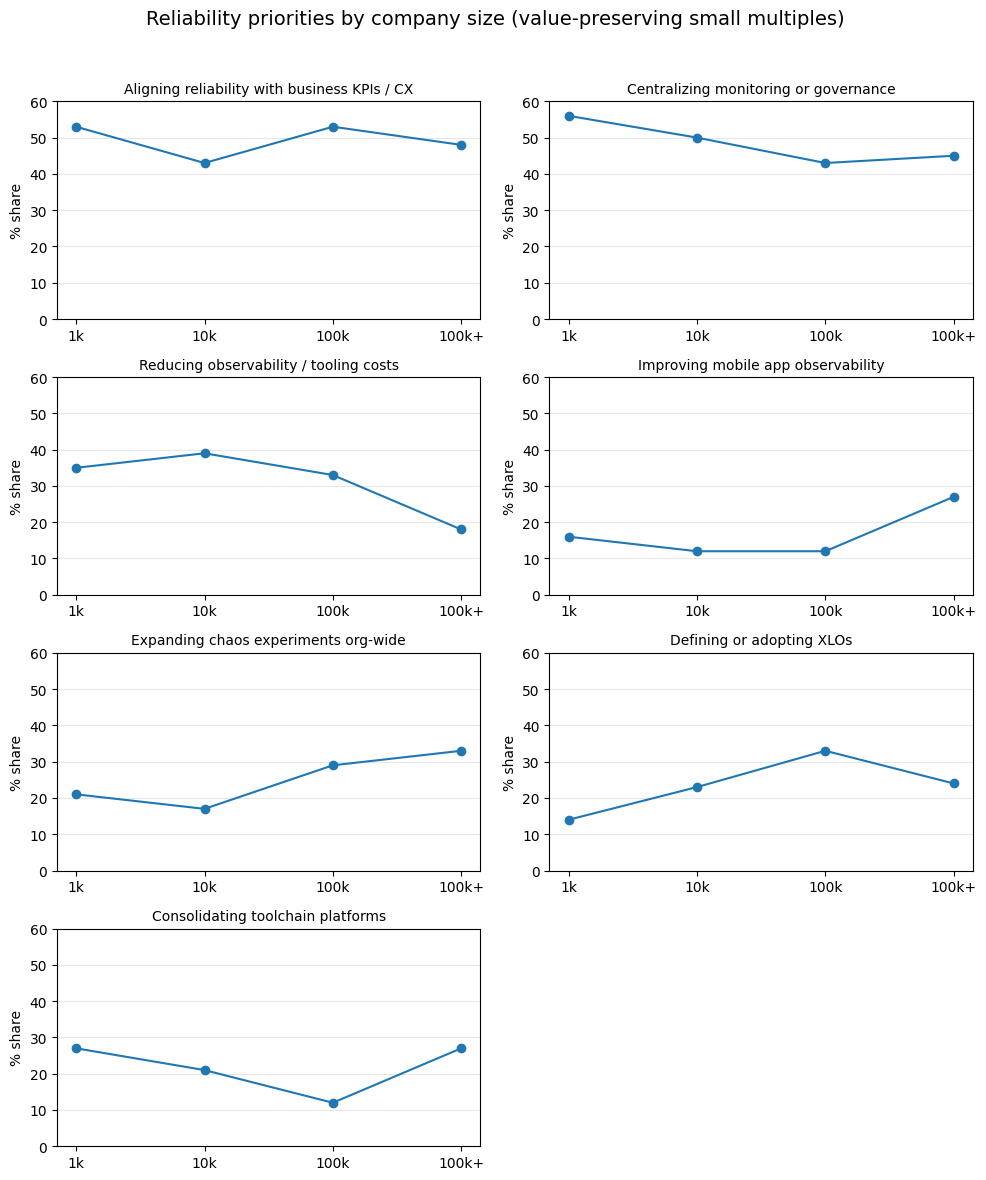
Where size changes the picture is in how alignment is enforced. Larger organizations show greater urgency around formal mechanisms such as XLOs, which offer a way to define what fast enough means for the journeys that matter most. They convert expectation into measurement and measurement into accountability. As organizations grow, this structure becomes necessary to preserve trust across expanding customer bases and increasingly complex systems.
The closing reality
If degraded performance is as damaging as downtime, then monitoring must be treated as the system of record for trust.
It must tell you, continuously and credibly:
- where users are experiencing friction,
- how that friction maps to business outcomes,
- and whether the promises you’ve made are being kept.
Reliability viewed only through internal signals will always look healthier than it feels to customers. Reliability tied to business outcomes gains the visibility required for sustained investment.
Learn more
- Read the full SRE Report 2026
Explore the complete data and analysis behind how speed, reliability, and trust are changing across organizations. - See Internet Performance Monitoring in action
Request a demo to understand how IPM provides visibility across the Internet stack, including networks, providers, and dependencies outside your control. - Read: Cloud monitoring’s blind spot, the user perspective
Learn why monitoring only from the first-mile (cloud) can miss performance issues that affect real user experience and reliability.
Summary
This is some text inside of a div block.


